Most cargo held at a port is held because of paperwork, not because of the cargo. A consignee name that does not match the import license, a VIN with one wrong character or a container number copied from the wrong booking can all stop a container. Filling out the bill of lading carefully, and making sure it matches every other document, prevents almost all of it.
What a filled-in bill of lading looks like
Here is a complete house bill of lading made in Leonis Cargo for an example shipment of two used cars from Houston to Lagos. Every box below is explained in the sections that follow, so you can compare each one with this picture as you read.
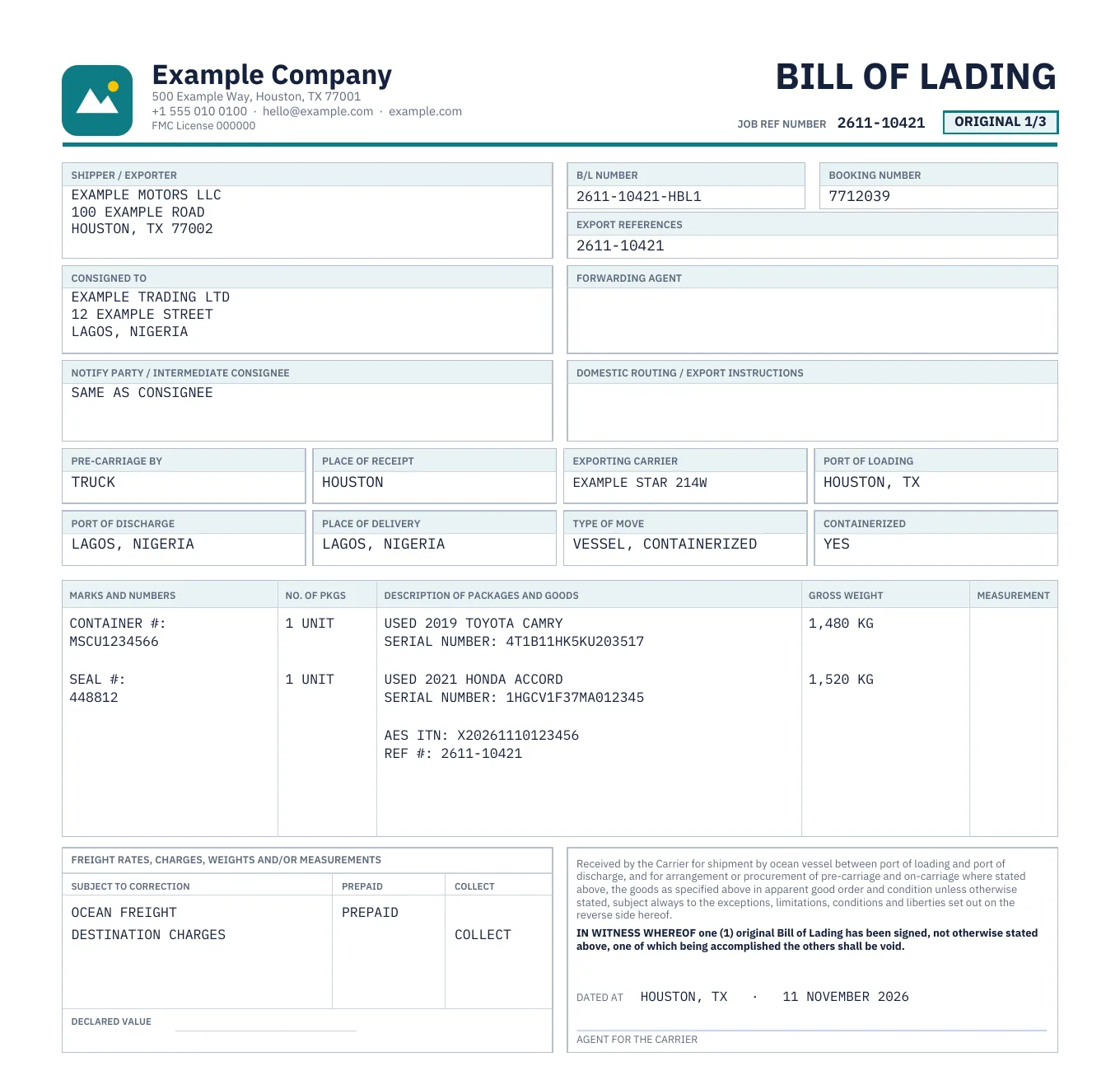
In Leonis Cargo you do not type a bill of lading at all: it fills itself in from the shipment, and you only check it and press Download. You can also fill in our free bill of lading template if you only need one.
Shipper, consignee, notify
Who sends the cargo, who it is for, and who is told when it arrives.
Receipt to delivery
Place of receipt, port of loading, vessel and voyage, port of discharge and place of delivery.
What is in the box
Containers, seals, packages, a clear description, every VIN and the weights.
How it is released
Freight prepaid or collect, and whether it is an Original, a Sea Waybill or a Telex Release.
The parties: shipper, consignee and notify party
The shipper is the person or company sending the cargo, with their full name, address and phone number. In the United States, exporters often add their EIN; in the European Union and the United Kingdom, their EORI number.
The consignee is the person or company the cargo is for. It can be a named company, which makes the bill straight and non-negotiable, or it can say "To order" or "To order of" a bank or the shipper, which makes an original bill negotiable so it can be passed on by endorsement. The consignee name should match the buyer's import documents exactly.
The notify party is who the carrier tells when the cargo arrives, often the buyer's customs broker. If it is the same as the consignee, many bills simply say SAME AS CONSIGNEE.
A bill of lading that fills itself in
Leonis builds the house bill of lading, dock receipt and invoice from one shipment, keeps every amendment, and lets you pick Original, Sea Waybill or Telex Release. Try it free for 7 days.
Start free trialThe route: from receipt to delivery
- Place of receipt: where the carrier takes charge of the cargo, if that is before the port, such as an inland warehouse.
- Port of loading: the port where the container is loaded on the ship.
- Vessel and voyage: the ship's name and the voyage number from the booking.
- Port of discharge: the port where the container comes off the ship.
- Place of delivery: where the carrier's responsibility ends, if that is after the port.
Use the port names as the carrier writes them, with the country, so there is no doubt, for example TEMA, GHANA rather than just Tema.
The cargo: containers, packages and the description
List each container number and its seal number. A container number has four letters and seven numbers, and the last number is a check digit, so it is easy to check before the bill is issued with the free container number checker.
Then give the number and kind of packages and a clear description. For vehicles, describe each one with the year, make and model and its full 17-character VIN, for example 1 USED 2018 TOYOTA CAMRY, VIN 4T1B11HK5JU123456. Add the export filing citation where it is required, such as AES X20261110123456 for a US export.
Finish with the gross weight and, for loose cargo, the measurement in cubic meters. Weights should match the booking and the export filing.
One price, everything included
$70 a month for each login, with every feature, 300 Leo AI jobs each month, no setup fee, no training to buy and no fee per document.
The terms: freight, bill type and originals
Freight prepaid means the freight is paid at origin, usually by the shipper. Freight collect means it is paid at destination, usually by the consignee, before the cargo is released.
The bill type decides how the cargo is released at destination:
- Original bill of lading: printed originals, usually a set of three, and the consignee must hand one in to collect the cargo. Used when payment depends on the documents, such as with a letter of credit.
- Sea Waybill: no original is needed; the named consignee can collect the cargo once they prove who they are.
- Telex Release: the originals are issued and then surrendered at origin, and the carrier tells its office at destination to release the cargo without them.
Finally, the bill shows the number of originals issued, and the place and date of issue, which is usually where and when the cargo was shipped on board.
House and master bills of lading
When a freight forwarder or NVOCC books the cargo with an ocean carrier, there are two bills. The carrier issues the master bill of lading to the forwarder, and the forwarder issues its own house bill of lading to its customer. The house bill names the real shipper and consignee; the master bill usually names the forwarder and its agent at destination.
The two must tell the same story: the same containers, seals, ports and vessel. Only the parties change.
Fill it out in minutes with Leonis
Filling out a bill of lading by hand means typing every box again for each shipment. In Leonis Cargo the bill of lading fills itself in from the shipment: parties, ports, vessel, containers, seals, cars and weights. You choose the bill of lading type and freight terms, issue it, and every amendment is kept. See bills of lading in Leonis, or use the free template for a single shipment.
Questions people ask
The basics
What is a bill of lading?
A bill of lading is the document a carrier issues for cargo it carries. It is a receipt for the cargo, evidence of the contract of carriage and, when it is an original, the document that controls who can collect the cargo at destination.
Who fills out the bill of lading?
The carrier or the forwarder that issues it fills it out, using the shipping instructions from the shipper. The shipper is responsible for giving accurate details, and the issuer is responsible for what it issues.
What information do I need before I fill out a bill of lading?
You need the shipper, consignee and notify party details, the booking with the vessel, voyage and ports, the container and seal numbers, the cargo description with package counts, weights and every VIN, the export filing citation, the freight terms and the bill type.
What is the difference between a house and a master bill of lading?
The ocean carrier issues the master bill to the forwarder or NVOCC, and the forwarder issues the house bill to its own customer. The house bill names the real shipper and consignee, while both bills describe the same cargo, containers and route.
The parties
What goes in the shipper box?
The full name, address and phone number of whoever is sending the cargo. US exporters often add their EIN, and exporters in the EU and UK their EORI number.
What goes in the consignee box?
The full name and address of the person or company the cargo is for, exactly as on their import documents, or "To order" wording if the bill is meant to be negotiable.
What does "To order" mean on a bill of lading?
It means the original bill is negotiable, so whoever holds it, properly endorsed, can collect the cargo. It is common when a bank is involved in the payment.
What is a notify party?
The notify party is who the carrier tells when the cargo arrives, often the consignee's customs broker. If it is the same as the consignee, the box can say SAME AS CONSIGNEE.
Who signs the bill of lading?
The carrier, or an agent or NVOCC signing for the carrier, signs the bill of lading. The shipper does not sign it as issuer.
Cargo and description
How should I describe cars on a bill of lading?
List each car with its year, make, model and full 17-character VIN, for example 1 USED 2018 TOYOTA CAMRY, VIN 4T1B11HK5JU123456, and make sure every VIN matches the title and the export filing.
Do container and seal numbers have to be on the bill of lading?
Yes. Each container number and its seal number should be shown, and they must match the booking and the container itself. A container number's last digit is a check digit, so a typing mistake is easy to catch.
What weight goes on the bill of lading?
The gross weight of the cargo, including packaging, in kilograms or pounds as agreed, and it should match the booking and the export filing.
Can the bill of lading show the value of the cargo?
There is often a box for a declared value. Leave it empty or write NIL unless a value has been agreed with the carrier, because a declared value can change the carrier's liability and the freight.
What goes in the place of receipt and place of delivery boxes?
The place of receipt is where the carrier takes the cargo if that is before the port of loading, and the place of delivery is where the carrier hands it over if that is after the port of discharge. Leave them empty for port-to-port shipments.
What goes in the vessel and voyage box?
The name of the ship and the carrier's voyage number for the sailing, exactly as they appear on the booking.
What goes in the number of packages box for cars?
Usually the number of vehicles, such as 4 units, with each car described by year, make, model and VIN in the description.
What does said to contain mean on a bill of lading?
It means the carrier is recording what the shipper declared is inside a sealed container, without having checked it. That is why the shipper's description must be accurate.
Bill types and release
How many originals are issued?
A set of three originals is common, and the bill shows how many were issued. Any one of them, handed in at destination, is usually enough to collect the cargo.
What do freight prepaid and freight collect mean?
Freight prepaid means the freight is paid at origin, usually by the shipper. Freight collect means it is paid at destination, usually by the consignee, before the cargo is released.
When should I issue the final bill of lading?
Issue it once the cargo is shipped on board and the details are confirmed, and many forwarders wait until the customer has paid the invoice, especially for Original bills.
What is the shipped on board date?
It is the date the cargo was actually loaded on the vessel. Banks and buyers often check it, so it should match the real loading date.
Mistakes and changes
What are the most common bill of lading mistakes?
A consignee name that does not match the import documents, a VIN or container number with one wrong character, missing export filing numbers, wrong weights and port names without the country.
Can a bill of lading be changed after it is issued?
Yes. A corrected bill is issued as an amendment, and every earlier version should be kept. With Original bills, the old originals are usually surrendered before the corrected set is released.
How do I make sure the bill of lading matches the other documents?
Type each detail once, in one place, and print every document from it. In Leonis Cargo, the bill of lading, dock receipt and invoice all read from the same shipment, and a change on one document asks whether the others should change too.
Can software fill out the bill of lading for me?
Yes. In Leonis Cargo, the house bill of lading fills itself in from the shipment, and Leo can read the booking confirmation and vehicle titles to fill the shipment. You choose the bill type and freight terms, and you check everything before you issue it.
Have a question we did not answer? Ask Leo on the FAQ page, or start your free trial and try Leonis with your own shipments.
Sources
Rules change. The rules described on this page come from the official sources listed and were accurate when it was last updated, but governments and carriers change them without notice. Leonis Cargo makes software; it is not a customs broker, a lawyer or a licensed forwarder, and this page is not legal or customs advice. Always confirm the current rules with the authority or a licensed professional.